Most Companies Have Given Employees Access to AI. Few Have Turned It Into a Performance System.
Organizations have moved quickly to introduce AI.
Employees now have access to AI tools. Teams are using AI to summarize documents, generate ideas, draft emails, prepare presentations, research competitors, and improve productivity in small ways.
That is progress, but it is not transformation.
The real question is not whether people are using AI. It is whether AI is changing how people lead, sell, decide, and execute. There is a big difference between using AI tactically and applying AI systemically.
Most organizations are still at the tactical stage — they use AI as a helpful assistant. A manager asks AI to draft a feedback message. A salesperson asks AI to prepare questions for a customer meeting. A team uses AI to summarize meeting notes. A leader asks AI to generate a communication plan.
These are useful applications that save time and help people work faster. But do they change behaviour?
A manager may use AI to draft feedback but still avoid the difficult conversation. A salesperson may use AI to prepare discovery questions but still talk too much in front of the customer. A leader may use AI to summarize a plan but still struggle to align the team around execution.
Leaders confuse AI usage with AI impact.
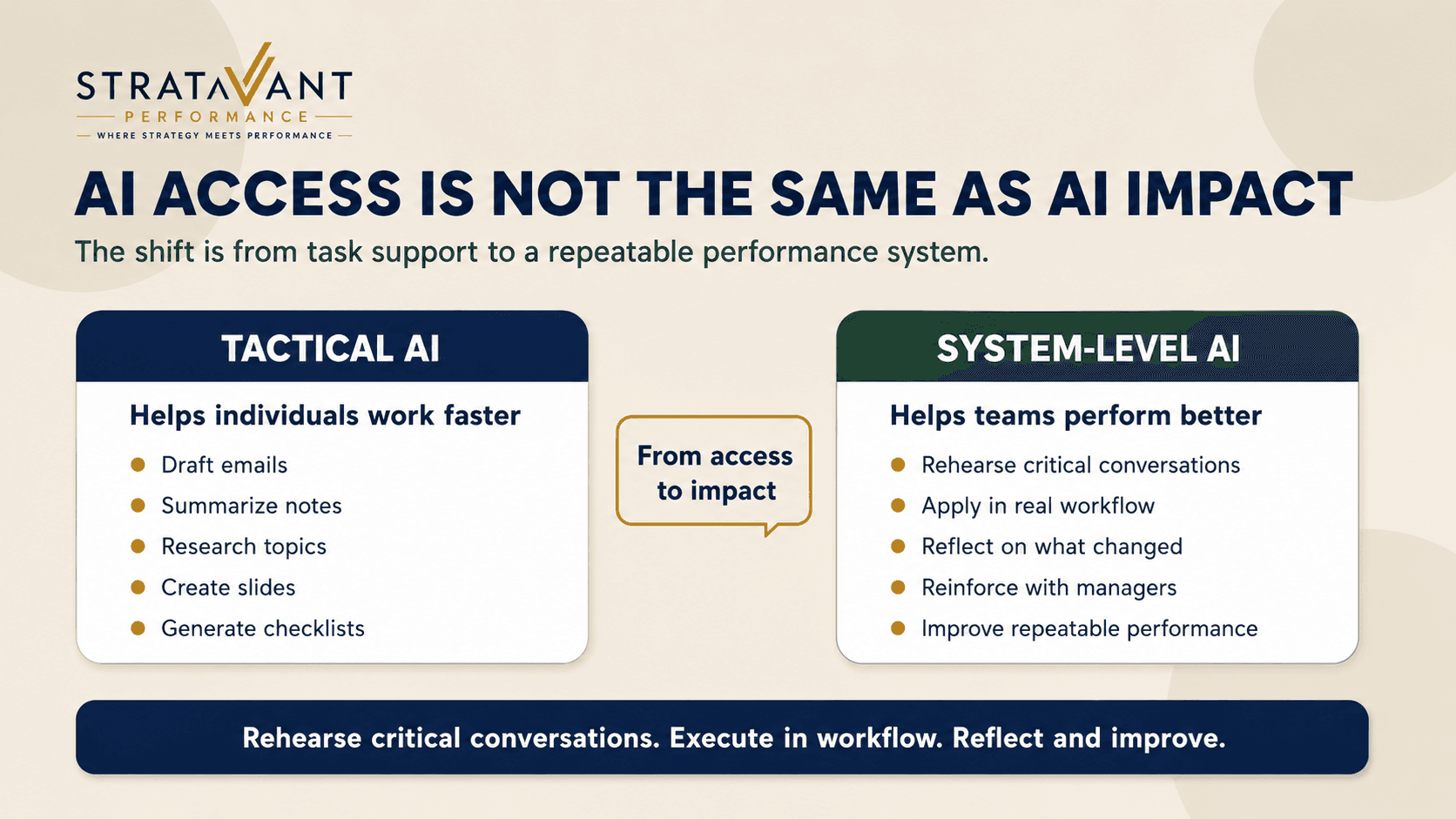
Tactical AI helps individuals work faster
At a tactical level, AI is usually used by individuals for task support. This is valuable, but it stays at the level of personal productivity. It may not make the team more effective. Work may move faster, but the behaviour may not change.
The organization may have more AI-generated content, but not necessarily better leadership conversations, stronger sales execution, clearer accountability, or improved decision-making.
That is the gap leaders need to recognize.
AI access is not the same as AI-enabled transformation.
System-level AI changes how work gets done
At a system level, AI is not used only to produce content. It is designed into the workflow to improve how people perform.
This means AI becomes part of the development, practice, execution, and reflection system.
For example, instead of using AI only to draft a feedback script, a leader rehearses the actual conversation with an AI character before speaking to the employee.
The AI character pushes back. The employee becomes defensive. The conversation becomes uncomfortable. The leader has to practise staying calm, using evidence, explaining impact, and inviting dialogue.
That is different from asking AI for a suggested script.
One produces content. The other builds behavioural muscle.
In sales, the same principle applies.
Instead of using AI only to generate customer questions, a salesperson rehearses a real customer conversation. The buyer challenges price. The procurement leader asks for a discount. The clinical stakeholder questions the value. The CFO asks for proof of business impact.
The salesperson must practise listening, probing, reframing value, and holding commercial discipline.
Again, that is different from using AI to prepare notes.
One supports preparation. The other improves execution.
This is where AI becomes powerful: not as a shortcut to produce more material, but as a system to help people practise the moments that matter.
Leaders and managers need to think beyond tools
This is where the role of leaders and managers becomes critical. If leaders see AI only as a productivity tool, they will ask: “How can my team use AI to save time?” That is a useful question, but it is not enough.
A stronger question is: “How can AI help my team perform better in the moments that determine business results?” That changes the conversation.
For HR leaders, it means asking whether AI can help managers rehearse difficult conversations before they happen; support coaching, feedback, accountability, and performance conversations; provide practice data beyond workshop attendance and satisfaction scores; and help managers reinforce learning after the formal program ends.
For Sales Leaders, it means asking whether AI can help salespeople rehearse high-stakes customer conversations; simulate pricing pressure, stakeholder resistance, procurement challenge, and competitive threats; help sales managers coach around real deal quality; and move sales training closer to actual revenue execution.
These are system-level questions. They move AI from individual productivity into business performance.
APAC teams need practical, workflow-based AI adoption
Across APAC, many teams are still learning how to make AI practical. There is interest, but there is also hesitation.
Some employees are experimenting. Some are unsure where to start. Some managers are waiting for direction from headquarters. Some organizations have provided access to tools but have not redesigned how people learn, practise, and apply new behaviours.
This is understandable. But it is also a missed opportunity.
AI adoption cannot be left only to individual initiative. If organizations want meaningful impact, leaders need to design AI into the way teams build capability and execute work.
This is especially important in leadership and sales, where performance depends heavily on conversation quality.
Many business outcomes are shaped by conversations: the feedback conversation a manager avoids, the coaching conversation that builds ownership, the accountability conversation that resets standards, the discovery conversation that uncovers real customer needs, the negotiation conversation that protects value, and the performance conversation that determines whether someone grows or disengages.
These moments matter. They are also difficult to practise at scale using traditional methods alone.
This is where AI can help.
StrataVant’s view: AI should build performance, not just productivity
At StrataVant, we believe AI should not be treated as a novelty or a content-generation tool. AI should be designed into a performance system.
That means using AI to help people learn the concept with enough clarity to act; rehearse critical conversations before they happen; execute the behaviour in the real workflow; and reflect on what worked, what did not, and what to improve next.
This is the difference between AI as a tool and AI as a system.
A tool helps someone complete a task. A system helps a team build repeatable performance.
For leadership development, this means helping new and emerging leaders practise feedback, coaching, accountability, goal-setting, and performance conversations.
For sales development, this means helping sales teams practise discovery, objection handling, stakeholder influence, value defence, and negotiation under pressure.
The goal is not to replace human judgment. The goal is to create more practice before real business moments happen.
Access is only the beginning
Many organizations have taken the first step by giving employees access to AI. That matters.
But access alone will not transform leadership quality, sales execution, or team performance.
The next step is harder. It requires leaders to ask better questions.
Where are the critical moments in our business where people need to perform better? Which conversations determine whether teams align, customers trust us, or performance improves? Where do our managers and salespeople need more practice before the real moment? How can AI be embedded into the learning and workflow system, rather than left as a personal productivity tool?
These questions matter because the competitive advantage will not come from simply having AI. Most companies will have that.
The advantage will come from how deliberately organizations use AI to improve behaviour, execution, and performance.
The leadership challenge
Business leaders, HR leaders, and Sales Leaders have a choice.
They can allow AI adoption to remain tactical, fragmented, and dependent on individual curiosity. Or they can build systems that help people practise, apply, reflect, and improve.
The first path creates pockets of productivity. The second path creates organizational capability.
Few have turned AI into a system that changes how people lead, sell, and execute.
StrataVant helps APAC teams rehearse critical business conversations before they happen — then apply, reflect, and improve in the real workflow.
The future of AI in business is not just about working faster. It is about performing better when it matters.